Managed Kubernetes is a cloud service where the provider takes responsibility for your Kubernetes control plane, upgrades, and infrastructure maintenance. Your team focuses on deploying and scaling applications. The cluster management work happens in the background.
For Indian businesses, choosing between managed Kubernetes providers comes down to where your data lives, what currency your bill arrives in, and how quickly someone picks up when something breaks.
This guide compares six managed Kubernetes providers available to Indian businesses in 2026. It covers pricing in INR, India data centre availability, DPDP compliance readiness, and a clear decision framework for IT heads and DevOps teams evaluating their options.
What is managed Kubernetes?
Kubernetes is an open-source system for automating the deployment, scaling, and management of containerised applications. Running it yourself means your team maintains the control plane, handles upgrades, patches nodes, and manages cluster failures. That is significant operational overhead.
Managed Kubernetes removes that burden. The cloud provider operates the control plane. Your team retains control of what runs on the cluster. You deploy, scale, and manage your applications. Everything underneath is handled.
This is the core difference between managed Kubernetes services and self-hosted Kubernetes.
Managed vs unmanaged Kubernetes
| Managed | Unmanaged (self-hosted) | |
| Control plane | Provider manages | Your team manages |
| Upgrades | Automated | Manual |
| Node patching | Partially or fully automated | Manual |
| Operational cost | Lower (less ops time) | Higher (more ops time) |
| Base cost | Higher subscription | Lower subscription, higher team cost |
| Best for | Teams without dedicated K8s ops | Teams with a strong DevOps bench |
Three factors that matter for Indian businesses
For Indian businesses evaluating managed Kubernetes providers, three factors matter most.
- Data residency: The Digital Personal Data Protection Act (DPDP) 2023 requires that personal data of Indian users remains within Indian borders. If your Kubernetes workloads process personal data, your cluster must be hosted in India. The pricing table below includes a DPDP column for each provider.
- Billing currency: Most hyperscalers bill in USD. For Indian companies reporting in INR, dollar-denominated cloud invoices create budget unpredictability every time the rupee moves. A provider billing in INR gives you cost certainty.
- Support response time: AWS and Azure standard support plans respond in 24 to 48 hours. For teams running production workloads, that is too long. Ask every provider what their actual P1 support SLA is before you sign.
Top 5 managed Kubernetes providers in India (2026)
1. Google Kubernetes Engine (GKE)
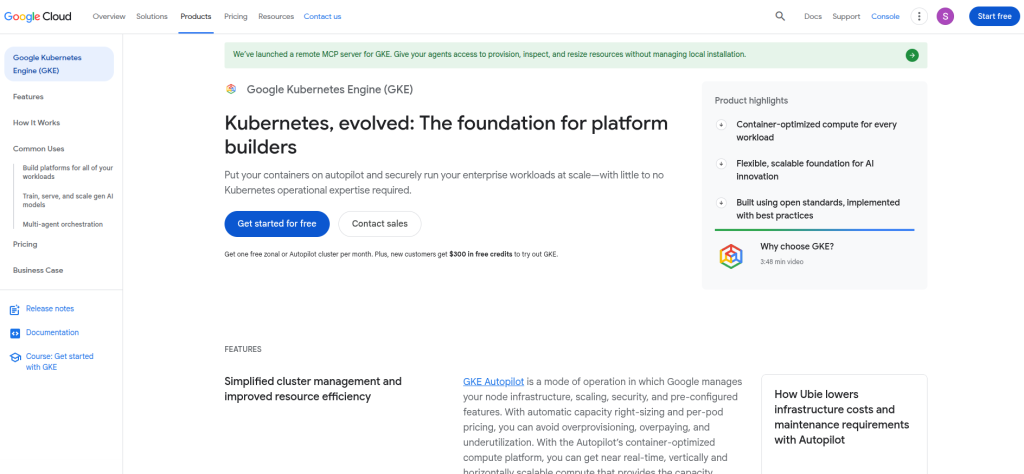
Google Kubernetes Engine (GKE) is Google Cloud’s managed Kubernetes service, available in India across Mumbai and Delhi, with a free control plane in Standard mode.
It offers two operating modes: Standard, where you manage nodes, and Autopilot, where Google manages nodes and you pay per pod.
Key features:
- Standard and Autopilot cluster modes
- Integration with Vertex AI, BigQuery, Cloud Run
- Multi-cluster management through GKE Enterprise
- Automatic upgrades and node auto-repair
- Available in Mumbai (asia-south1) and Delhi (asia-south2)
Pros:
- No control plane fee on Standard clusters
- Strong fit for AI and ML workloads using Google Cloud services
- Large community and extensive documentation
Cons:
- Billed in USD; INR conversion adds invoice unpredictability
- Egress fees apply when data leaves Google’s network
- Autopilot pricing is difficult to forecast for variable workloads
- Enterprise support tiers are expensive for mid-market Indian businesses
India availability: Mumbai (asia-south1), Delhi (asia-south2)
Approximate pricing (1-node cluster)
- Control plane: Free (Standard mode)
- Worker node, 2 vCPU / 8 GB RAM: approx. Rs. 4,000 to Rs. 5,000 per month
- USD-denominated; actual cost varies with exchange rate
Best for: Teams already running significant GCP workloads, AI and ML teams using Vertex AI, organisations with existing Google Cloud commitments.
2. CloudPe Kubernetes
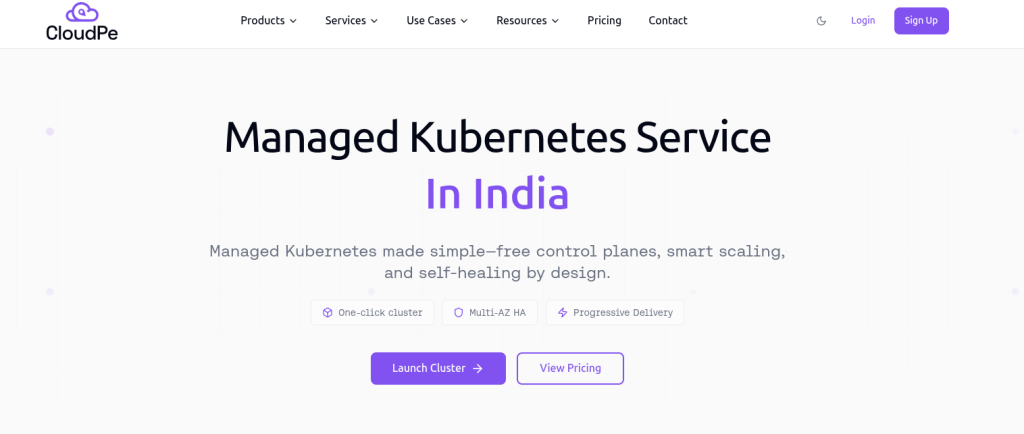
CloudPe Kubernetes is a managed Kubernetes service with a free control plane, free K8s license, and worker nodes priced at standard VM rates in INR, running on NVMe-backed infrastructure across four India locations.
The control plane is included at no charge. You pay only for the worker nodes you run, at the same VM pricing published on cloudpe.com/pricing. A 2 vCPU / 8 GB worker node costs Rs. 1,182 per month. A 4 vCPU / 16 GB node costs Rs. 2,079 per month. No licensing fee on top. No egress charges up to 1 TB.
Clusters launch with one click. Multi-AZ high availability, self-healing pods, horizontal pod autoscaling, and automated control plane upgrades are included as standard. Prometheus-based monitoring and centralized logs give full cluster visibility without additional tooling. NGINX ingress with automated Let’s Encrypt SSL is built in.
For AI and ML workloads, GPU-backed node pools are available on the same platform and the same account, with NVIDIA H200, H100, and A100 accessible without switching providers. Kubernetes also runs on bare-metal servers if your workload demands dedicated physical compute.
Key features:
- Free control plane and free K8s license (₹0)
- One-click cluster launch, multi-AZ HA
- Self-healing pods and automated version upgrade
- Horizontal Pod Autoscaling on CPU, memory, or custom metrics
- NGINX ingress with automatic Let’s Encrypt SSL
- Prometheus monitoring and centralised logs included
- CSI-backed persistent volumes with automatic provisioning
- GitOps-ready with CI/CD integration and automated rollback
- GPU-backed node pools: NVIDIA H200, H100, A100
- Kubernetes on bare-metal supported
- Zero-Trust pod networking, native service discovery
Pros:
- Free control plane and K8s license, pay only for worker nodes
- INR billing with published pricing, no hidden fees
- Free egress up to 1 TB
- Worker node costs 20 to 60% lower than hyperscalers on equivalent compute
- GPU node pools on the same platform and billing account
- Four India data centres: Mumbai, Pune, Delhi, Bengaluru
- 24/7 support with under 2-hour resolution time
- DPDP-ready; data stays in India
Cons:
- Newer platform compared to hyperscalers; smaller global footprint
- No data centre presence outside India currently
India availability: Mumbai, Pune, Delhi, Bengaluru
Pricing:
- Control plane: Free (₹0)
- K8s license: Free (₹0)
- Worker node, 1 vCPU / 4 GB: Rs. 930/month
- Worker node, 2 vCPU / 8 GB: Rs. 1,182/month
- Worker node, 4 vCPU / 16 GB: Rs. 2,079/month
- Worker node, 8 vCPU / 32 GB: Rs. 3,904/month
- Egress: Free up to 1 TB/month
Best for: Indian enterprises migrating off AWS or Azure on cost or compliance grounds, DevOps teams running containerised workloads that must stay in India, and AI and ML teams that need Kubernetes with GPU node pools on a single India-based platform.
3. Amazon Elastic Kubernetes Service (EKS)
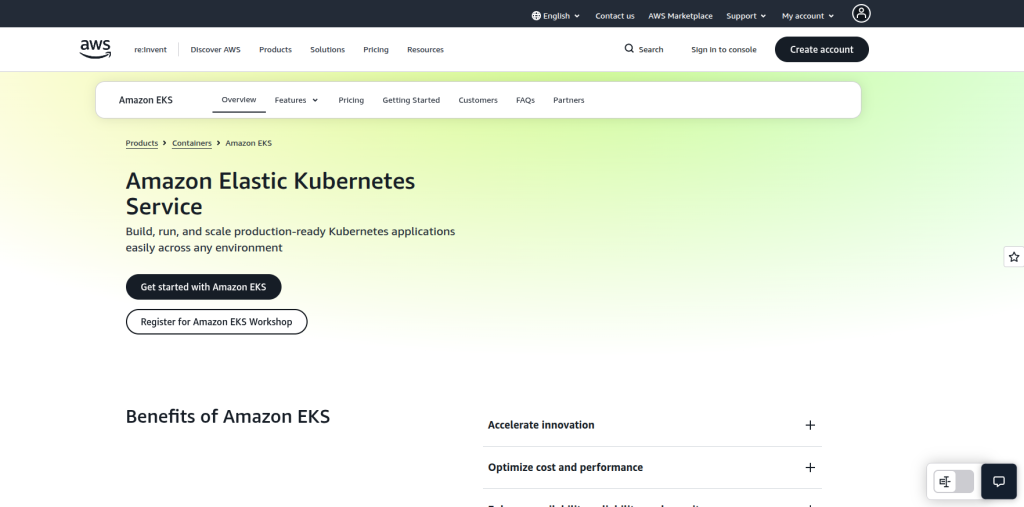
Amazon Elastic Kubernetes Service (EKS) is AWS’s managed Kubernetes service and the most widely deployed globally, with deep integration across IAM, VPC, ALB, and ECR.
Key features:
- Deep integration with AWS services across networking, security, and observability
- Managed node groups and Fargate for serverless node management
- Available in Mumbai (ap-south-1)
- Strong multi-account and multi-region support
Pros:
- Industry-standard; large talent pool with EKS experience
- Fargate removes node management entirely
- Strong security tooling through IAM and GuardDuty
Cons:
- Control plane costs approximately Rs. 6,000 to Rs. 7,000 per month per cluster, before a single workload runs
- Billed in USD with no INR option
- IAM and networking configuration requires dedicated AWS expertise to manage well
- Egress fees are significant for high-traffic Indian applications
India availability: Mumbai (ap-south-1)
Approximate pricing (1-node cluster)
- Control plane: approx. Rs. 6,000 to Rs. 7,000 per month
- Worker node, 2 vCPU / 8 GB RAM: approx. Rs. 5,500 to Rs. 6,500 per month
- Indicative total for a basic cluster: Rs. 12,000 to Rs. 14,000 per month, before egress
- USD-denominated; actual cost varies with exchange rate
Best for: Organisations deeply invested in AWS infrastructure that need Kubernetes integrated with existing AWS services and tooling.
4. Azure Kubernetes Service (AKS)
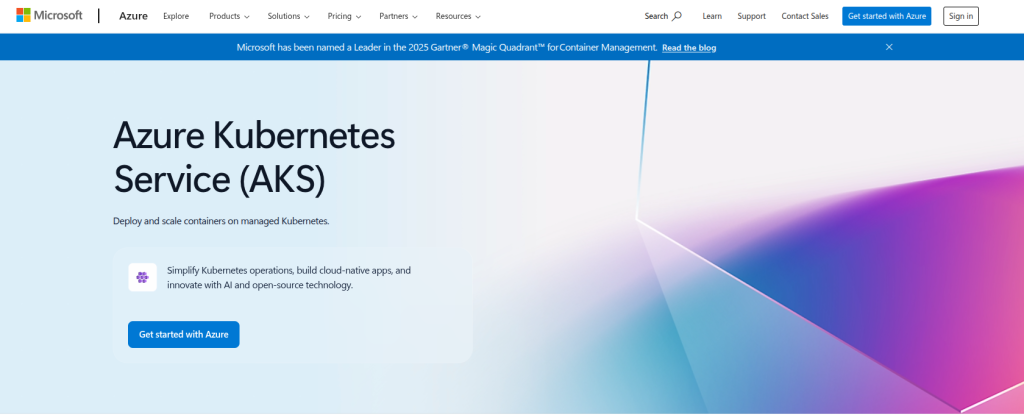
Azure Kubernetes Service (AKS) is Microsoft’s managed Kubernetes service, with a free control plane and native integration with Microsoft Entra ID and Azure DevOps.
Key features:
- Free control plane; you pay only for worker nodes
- Native integration with Microsoft Entra ID for identity and access management
- Azure Monitor andAzure Policy built in
- Available in Pune (Central India) and Chennai (South India)
Pros:
- No control plane fee, which reduces base cost compared to EKS
- Strong identity management for organisations inside the Microsoft stack
- Good hybrid cloud support for teams with on-premises Microsoft infrastructur
Cons:
- Billed in USD with no INR option
- Licensing complexity, particularly around Windows nodes and Microsoft software
- Slower release cadence compared to GKE
- Standard support response time of 24 to 48 hours
India availability: Pune (Central India), Chennai (South India)
Approximate pricing (1-node cluster)
- Control plane: Free
- Worker node, 2 vCPU / 8 GB RAM (Standard_D2s_v3): approx. Rs. 5,500 to Rs. 6,500 per month
- USD-denominated; actual cost varies with exchange rate
- Best for: Enterprises running sign
Significant Microsoft infrastructure and DevOps teams using Azure pipelines.
5. DigitalOcean Kubernetes (DOKS)
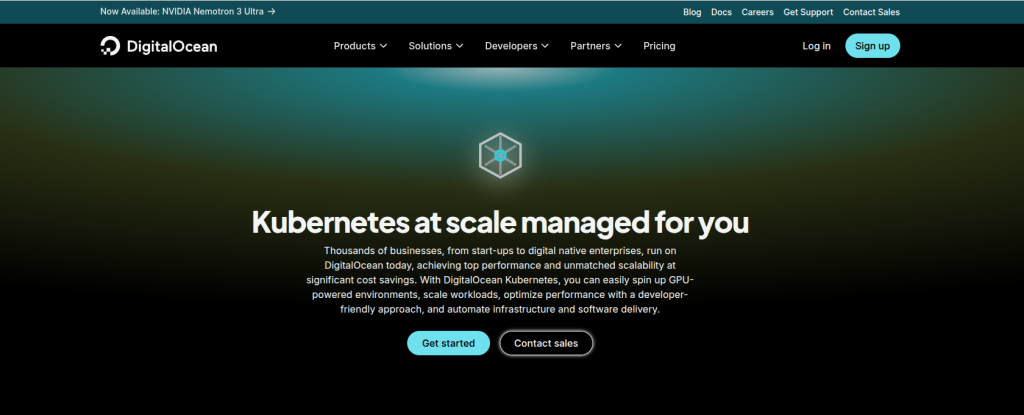
DigitalOcean Kubernetes (DOKS) is DigitalOcean’s managed Kubernetes service, known for simple pricing and fast provisioning, with the nearest region to India in Singapore.
Key features:
- Free control plane
- Simple, predictable pricing
- Managed upgrades and auto-healing nodes
- Fast cluster provisioning
Pros:
- Predictable pricing with no hidden fees
- Good developer experience and documentation
- Practical for development, staging, and smaller production workloads
Cons:
- No India data centre; the nearest region is Singapore, which does not satisfy DPDP data residency requirements for Indian personal data
- Limited enterprise-grade features compared to GKE, EKS, or AKS
- Billed in USD
India availability: None. Nearest region: Singapore.
Approximate pricing (1-node cluster, Singapore)
- Control plane: Free
- Worker node, 2 vCPU / 8 GB RAM: approx. Rs. 4,000 per month
- USD-denominated; actual cost varies with exchange rate
Best for: Global startups running workloads with no India data residency requirement.
Managed Kubernetes pricing comparison (India, 2026)
The table below shows indicative costs for a basic 1-node cluster with a 2 vCPU / 8 GB RAM worker node. INR figures for USD-denominated providers are approximate and will vary with exchange rate.
| Provider | Control plane | Worker node (2 vCPU / 8 GB) | Billing | India DC | DPDP ready | P1 support |
| GKE | Free | Rs. ~4,000 to 5,000/month | USD | Yes | Partial | 24 to 48 hrs |
| CloudPe | Free (₹0) | Rs. 1,182/month | INR | Yes | Yes | Under 2 hrs |
| EKS | Rs. ~6,000 to 7,000/month | Rs. ~5,500 to 6,500/month | USD | Yes | Partial | 24 to 48 hrs |
| AKS | Free | Rs. ~5,500 to 6,500/month | USD | Yes | Partial | 24 to 48 hrs |
| DigitalOcean | Free | Rs. ~4,000/month (Singapore) | USD | No | No | 24 to 48 hrs |
A note on egress: GKE, EKS, and AKS charge egress fees when data leaves their network. For high-traffic Indian applications, this adds meaningfully to a monthly invoice. CloudPe charges Rs. 0 in egress fees up to 1 TB per month.
How to choose the right managed Kubernetes provider
Quick decision guide:
| Your situation | Start here |
| Already deep in AWS | EKS |
| Already deep in Azure or Microsoft | AKS |
| AI and ML workloads on Google Cloud | GKE |
| India compliance required, INR billing | CloudPe |
| Startup, no India data requirement | DigitalOcean, CloudPe |
Your cloud strategy
If your existing workloads are already running on AWS, Azure, or GCP, migrating to a different platform involves real switching costs. Evaluate whether those costs are justified by the savings or compliance benefits before deciding.
Starting fresh, or with a specific India compliance requirement, the decision is more straightforward. Data residency and billing currency are the first two filters to apply.
Your workload type
Stateless microservices, APIs, and web applications run well on most providers.
Stateful applications, databases, and high-I/O workloads require consistent storage performance. Ask for benchmark data before committing to any provider for these workloads.
AI and ML pipelines require GPU access. If your Kubernetes workloads include model training or inference, you need a provider where GPU instances are on the same platform, with the same billing and networking, not a separate service.
Compliance requirements
DPDP 2023 applies to any organisation processing personal data of Indian users. Your Kubernetes cluster must be hosted in India.
RBI and SEBI compliance adds data localisation requirements for BFSI organisations. Government procurement often requires MEITY empanelment.
DigitalOcean has no India data centres; all other five providers on this list do. GKE, EKS, and AKS all have India regions. Their DPDP-specific compliance documentation is still developing.
Your in-house Kubernetes expertise
Low expertise means support quality matters more than feature depth. A provider whose team handles non-standard issues quickly is worth more than one with a deeper feature set and a ticket queue.
High expertise means your team can manage more of the cluster. The control plane cost becomes the main financial variable. This is where AKS’s free control plane makes a practical difference for large, stable clusters.
Is Kubernetes still relevant in 2026?
Yes. Kubernetes adoption continues to grow, particularly for containerised microservices, multi-cloud architectures, and AI and ML workloads where inference needs to scale dynamically.
In India, the shift from monolithic applications to containerised architectures is accelerating as mid-market enterprises modernise their infrastructure. DPDP compliance is also pushing more organisations toward managed cloud environments where they have clearer control over where workloads run.
For teams that previously avoided Kubernetes due to operational complexity, managed Kubernetes services have changed the calculation. If the provider handles the control plane, upgrades, and node management, Kubernetes is practical for teams that would not have run it themselves two years ago.
Frequently asked questions
What is managed Kubernetes?
Managed Kubernetes is a cloud service where the provider operates the Kubernetes control plane and handles upgrades and infrastructure maintenance. Your team deploys and manages applications on the cluster without managing the underlying infrastructure.
What is the difference between managed and unmanaged Kubernetes?
In managed Kubernetes, the cloud provider handles the control plane. In unmanaged or self-hosted Kubernetes, your team is responsible for cluster setup, upgrades, patching, and failure recovery.
What are the 4 types of services in Kubernetes?
The four Kubernetes service types are ClusterIP (internal cluster access only), NodePort (exposes the service on a static port on each node), LoadBalancer (exposes the service externally using a cloud load balancer), and ExternalName (maps the service to an external DNS name).
Which managed Kubernetes provider is best for India?
CloudPe is an India-native managed Kubernetes provider on this list. Both bill in INR and host data in India. GKE, EKS, and AKS have India regions but bill in USD and are better suited to teams already running workloads on those platforms.
Which provider is best for DPDP compliance?
Any provider with data centres physically located in India satisfies DPDP data residency requirements. DigitalOcean has no India data centres and cannot satisfy DPDP requirements for Indian personal data.
Is GKE a managed service?
Yes. GKE manages the Kubernetes control plane. In Standard mode, you manage the worker nodes. In Autopilot mode, Google manages nodes and bills per pod resource consumption.
How much does managed Kubernetes cost in India?
Costs range from Rs. 1,182 per month for a basic single-node cluster on CloudPe to Rs. 12,000 to Rs. 14,000 per month for a comparable EKS cluster including the control plane fee. GKE and AKS have free control planes but worker node costs are USD-denominated.
Is Kubernetes still relevant in 2026?
Yes. Kubernetes adoption continues to grow globally and in India, particularly for microservices, AI and ML workloads, and infrastructure modernisation. Managed Kubernetes reduces operational overhead enough to make it practical for teams that would not have run it themselves.